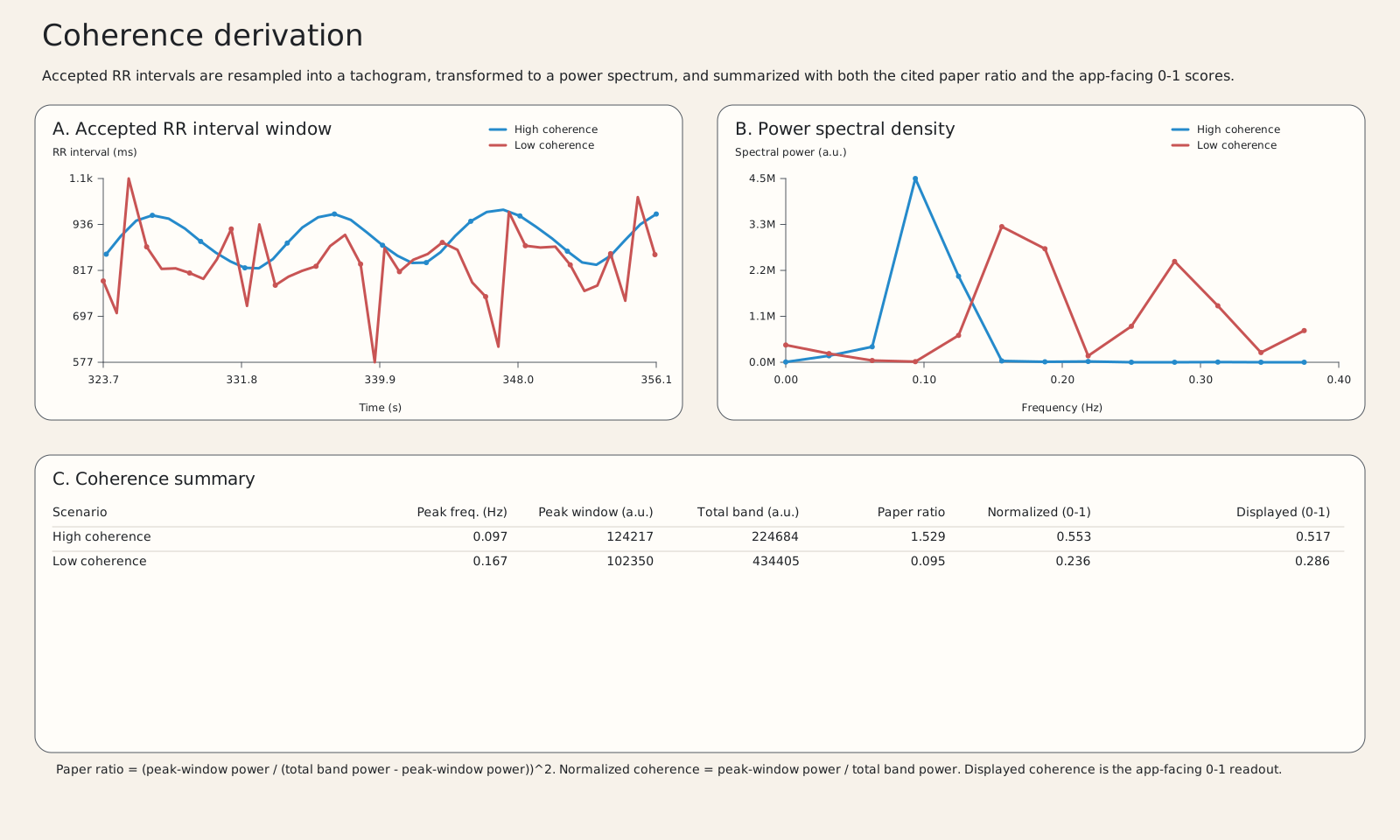
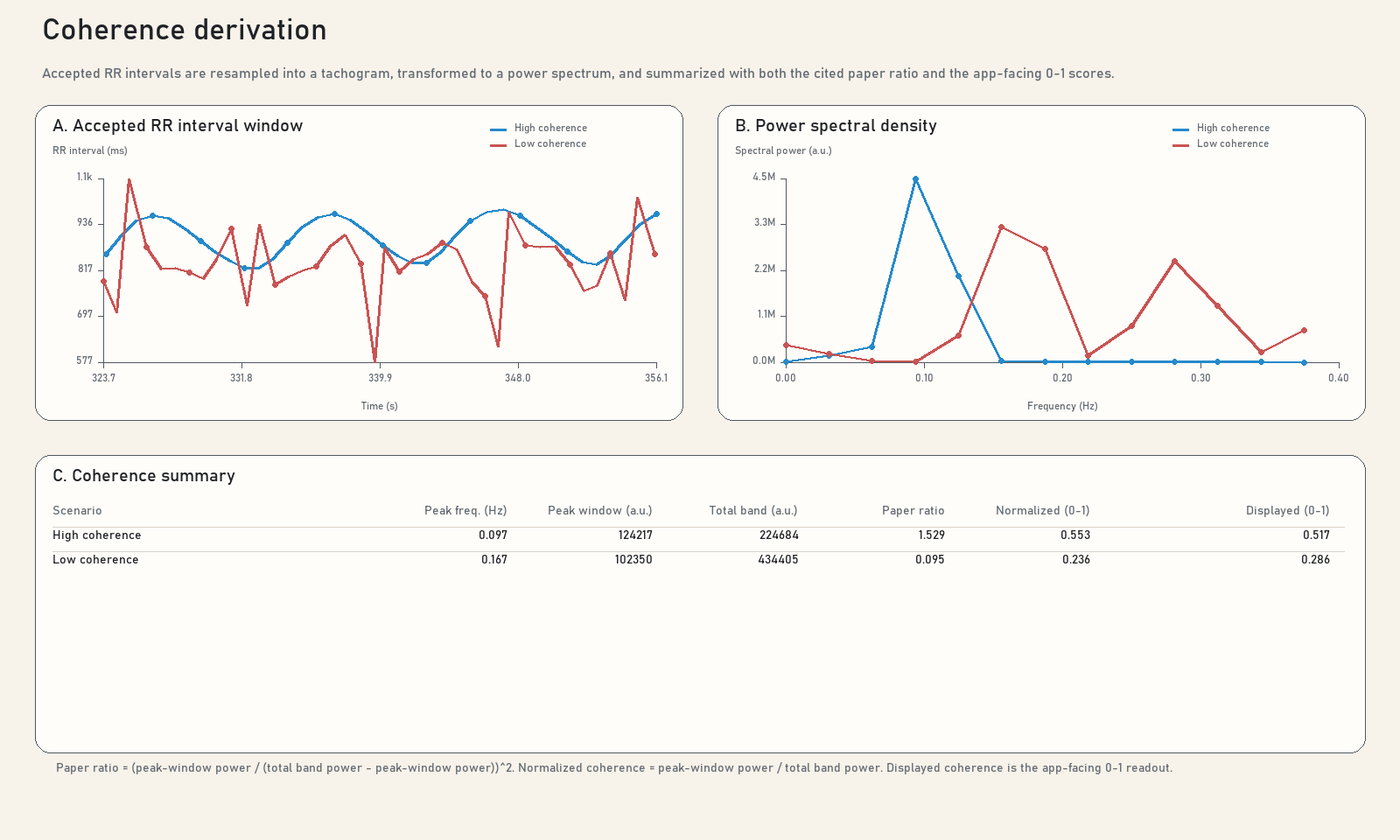
This page pairs coherence_high and coherence_low so the published figure
set can show how accepted RR intervals produce a narrowband spectral peak and,
in turn, higher coherence telemetry. The computation framing follows the
McCraty et al. coherence method documented in the
coherence formula sheet, while also separating the
paper-defined ratio from the app-facing 0..1 values exposed in PolarH10.
Open formula sheet Download derivation SVG Download appendix SVG
Source Files
Computation Path
AcceptedRrSamples
-> ResampledTachogram
-> PowerSpectrum
-> PeakBandPower / TotalBandPower
-> PaperCoherenceRatio / NormalizedCoherence01 / CurrentCoherence01
Coherence.Diagnostics.AcceptedRrSamplesexposes the accepted RR window used for the solve.Coherence.Diagnostics.ResampledTachogramexposes the spline-resampled tachogram that feeds the PSD step.Coherence.Diagnostics.PowerSpectrum,PeakWindowLowerHz,PeakWindowUpperHz,PeakBandPower, andTotalBandPowerexpose the peak search and integral terms.Coherence.Telemetry.PaperCoherenceRatiois the method-facing ratio described in the reference monograph.Coherence.Telemetry.NormalizedCoherence01is the app's boundedPeakBandPower / TotalBandPowervalue.Coherence.Telemetry.CurrentCoherence01is the displayed coherence value surfaced by the app UI and exported here for figure parity with the application.
Interpretation Notes
- The power spectral density is plotted in arbitrary units because the figure is meant to expose the computational path and relative separation between scenarios, not absolute spectral calibration.
- The figure is deterministic by design. It is an explanatory supplement, not a claim that these synthetic traces define normative coherence ranges.
Appendix Sweep
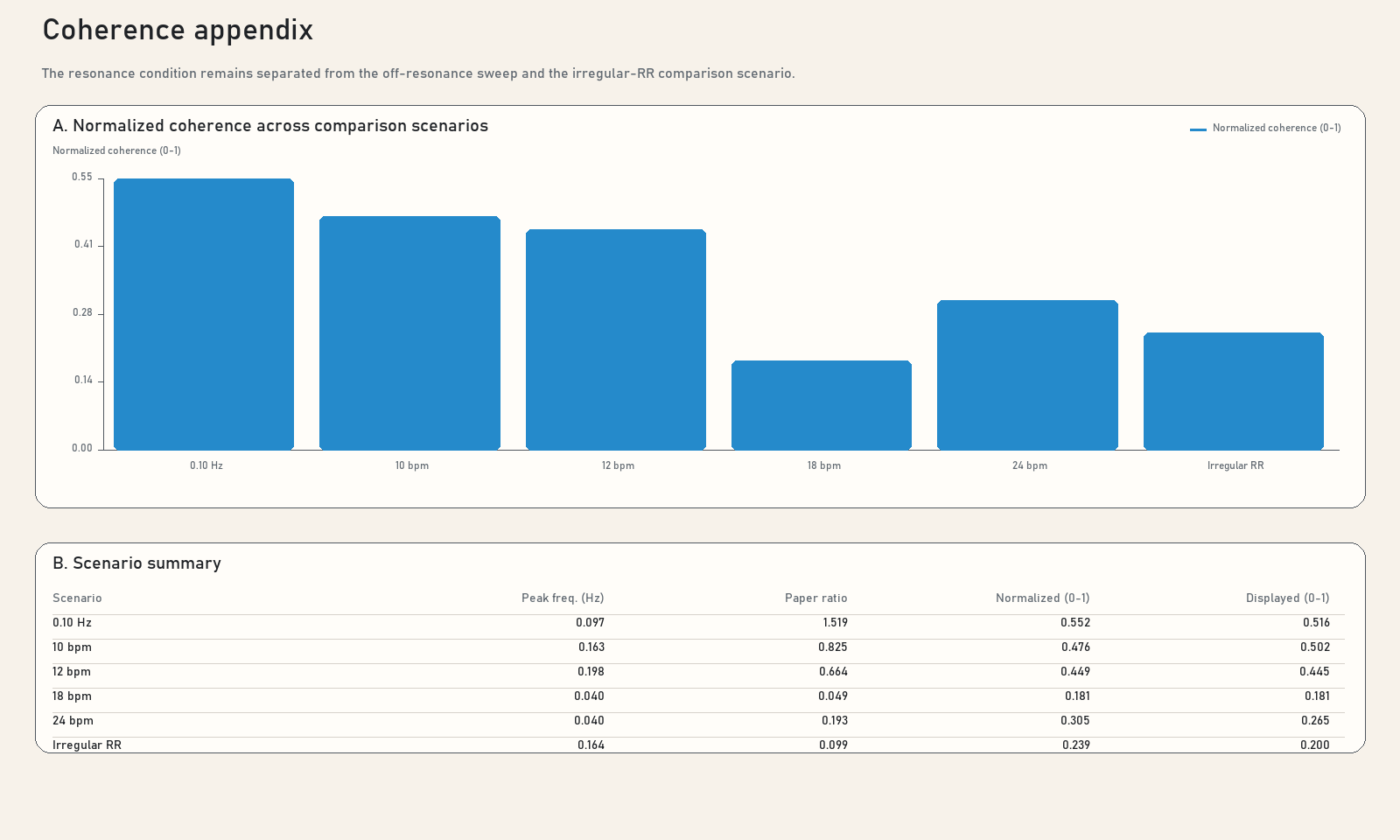
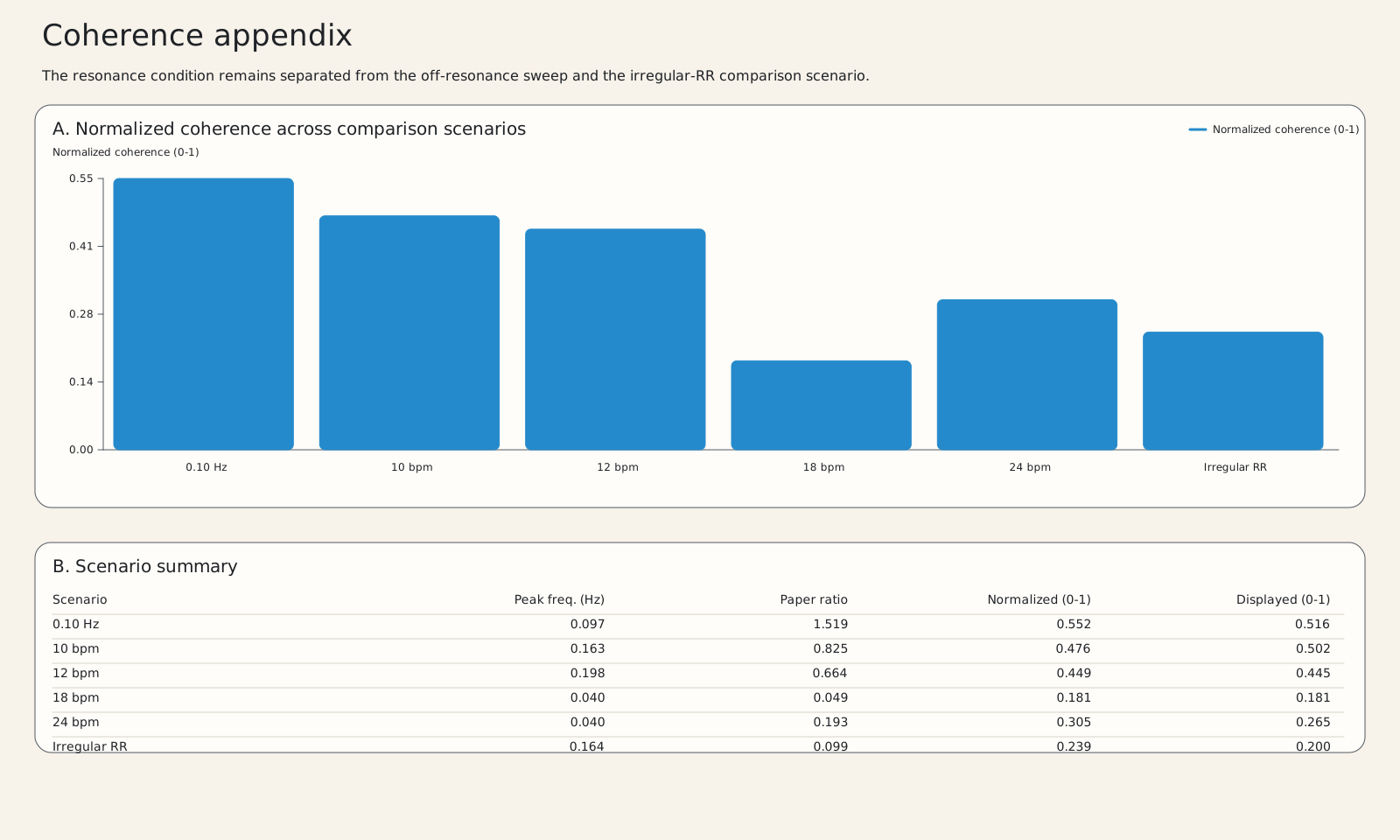
The appendix figure keeps the resonance and off-resonance comparison visible in the same publication bundle so authors can show that the strongest coherence separation occurs near the resonance-like condition while still documenting the intermediate off-resonance cases.
- resonance_010hz analysis
- off_10bpm analysis
- off_12bpm analysis
- off_18bpm analysis
- off_24bpm analysis
- irregular_rr analysis